
Chautauqua Court Records After Arrest
After a Chautauqua County jail arrest, the first record is usually a sheriff or jail booking record. That record belongs to the custody side of the case. It may list a warrant, arrest cause, commitment time, release time, bond note, or the agency that brought the person to jail. Kansas law also requires a sheriff to keep a prisoner calendar, so the jail side can matter even when no online roster exists.
The court record starts on a different track. The Chautauqua County Attorney, Christian Fazel, prosecutes traffic, misdemeanor, and felony offenses that occur in Chautauqua County. Once the prosecutor files the charge, the case moves through Kansas district court. The arrest may explain why a person entered jail, but the court record explains what the State chose to file and what the judge later did with each count.
That distinction is important because Chautauqua County has no official public jail roster, booking report, released-inmate index, warrant list, or mugshot gallery on the county site. For custody and booking details, use Chautauqua County jail inmate records. For booking photos, use the Chautauqua County jail mugshots page. Court records after a jail arrest should be checked through the Kansas court system, the District Court Clerk, and, when needed, a written records request.
Chautauqua Court CaseSearch Records
Chautauqua County is part of the 14th Judicial District. The county District Court page describes Kansas district courts as trial courts for civil and criminal cases. The local District Court office is at 215 N Chautauqua St, 3rd Floor, Sedan, and the published phone number is (620) 725-5870. Clerk offices for the 14th Judicial District are listed in Independence, Coffeyville, and Sedan.
The Kansas Judicial Branch explains public access to district court case information through its district court records page and the statewide Kansas CaseSearch portal. CaseSearch is the best first online stop once the prosecutor has filed charges after the arrest. A new booking may not appear there at once. First appearance, prosecutor review, filing, clerk processing, and portal updates can all affect timing.
The Kansas CaseSearch portal is the official court-access source for filed cases. The screenshot below comes from the Kansas CaseSearch portal, which is the public starting point for looking up a filed Chautauqua County court case after a jail arrest.
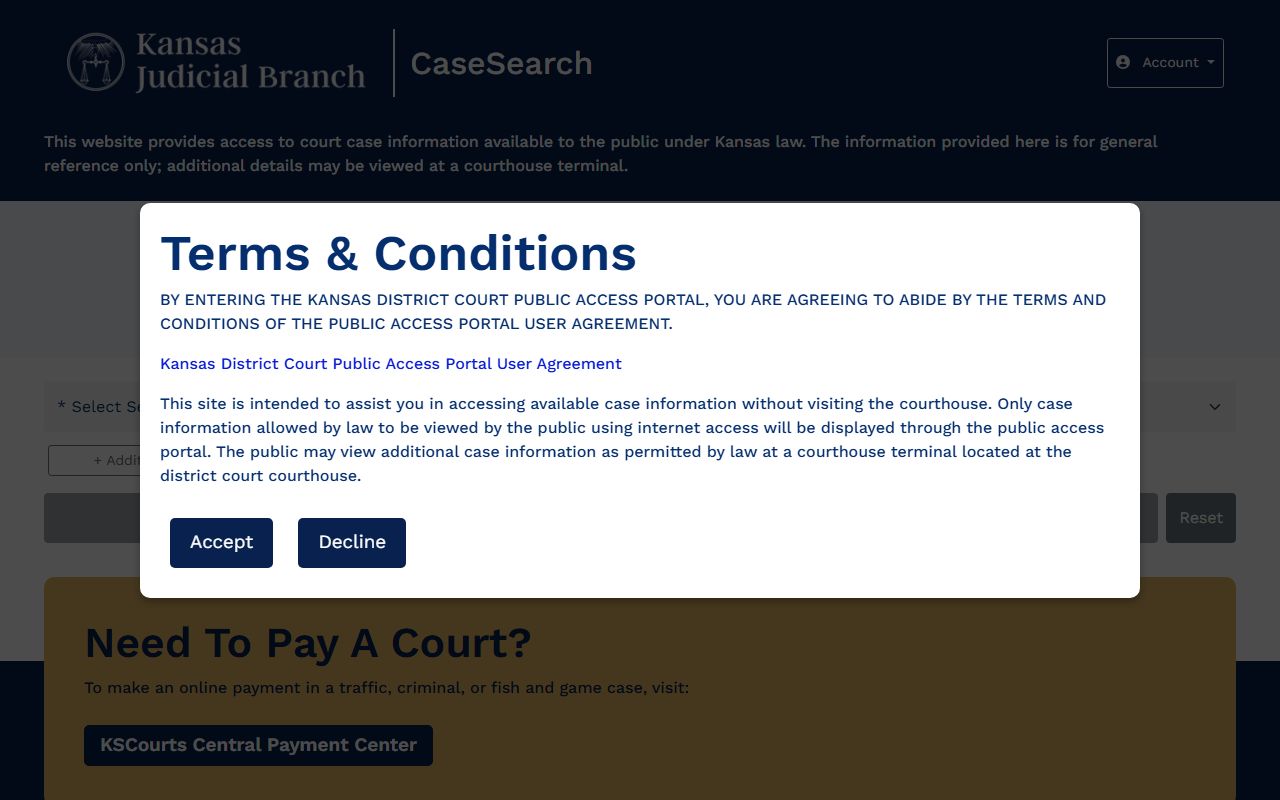
Use the portal to connect a defendant name or case number to the formal court case, then compare that case to jail information before assuming the charge wording is final.
- Confirm the arrest or custody status with the sheriff if the booking is recent and no case appears yet.
- Search Kansas CaseSearch by party name or case number after the case is likely filed.
- Open the criminal case and review case type, parties, attorney entries, judge assignment, hearings, and charge lines.
- Contact the District Court Clerk for certified copies, older files, unavailable records, or paper records not shown online.
The Kansas court-record request page is useful when an online search does not show the document needed. For Chautauqua County court records after arrest, the clerk is the better source for filed complaints, hearing dates, journal entries, certified copies, and local docket questions. The sheriff is the better source for current custody and booking calendar information.
Charges Filed After Chautauqua Arrest
A person may be booked on one set of words and charged under another. Jail language often comes from the arresting agency, warrant, probable-cause statement, or commitment paperwork. Court language comes from the prosecutor's filing and the court docket. That is why court records after a Chautauqua County arrest must be read from the filed case, not just from the custody entry.
Charging documents identify the count or counts the State is pursuing. The exact Kansas document used depends on the case. For a reader, the key point is that the charging document is where the court record begins to become more reliable than a booking label.
| Document | Who Uses It | What It Does |
|---|---|---|
| Complaint | Prosecutor, often early in the case | Starts many criminal cases by listing the alleged offense and basic charge basis. |
| Information | Prosecutor | Formally states charges the State is pursuing, often after review or preliminary proceedings. |
| Indictment | Grand jury process | Charges a case through grand jury action, used less often than ordinary prosecutor filings. |
The 14th Judicial District page gives the district context for Chautauqua County court records. The image below is from that district page and helps place Sedan in the court system that handles criminal filings after a jail arrest.
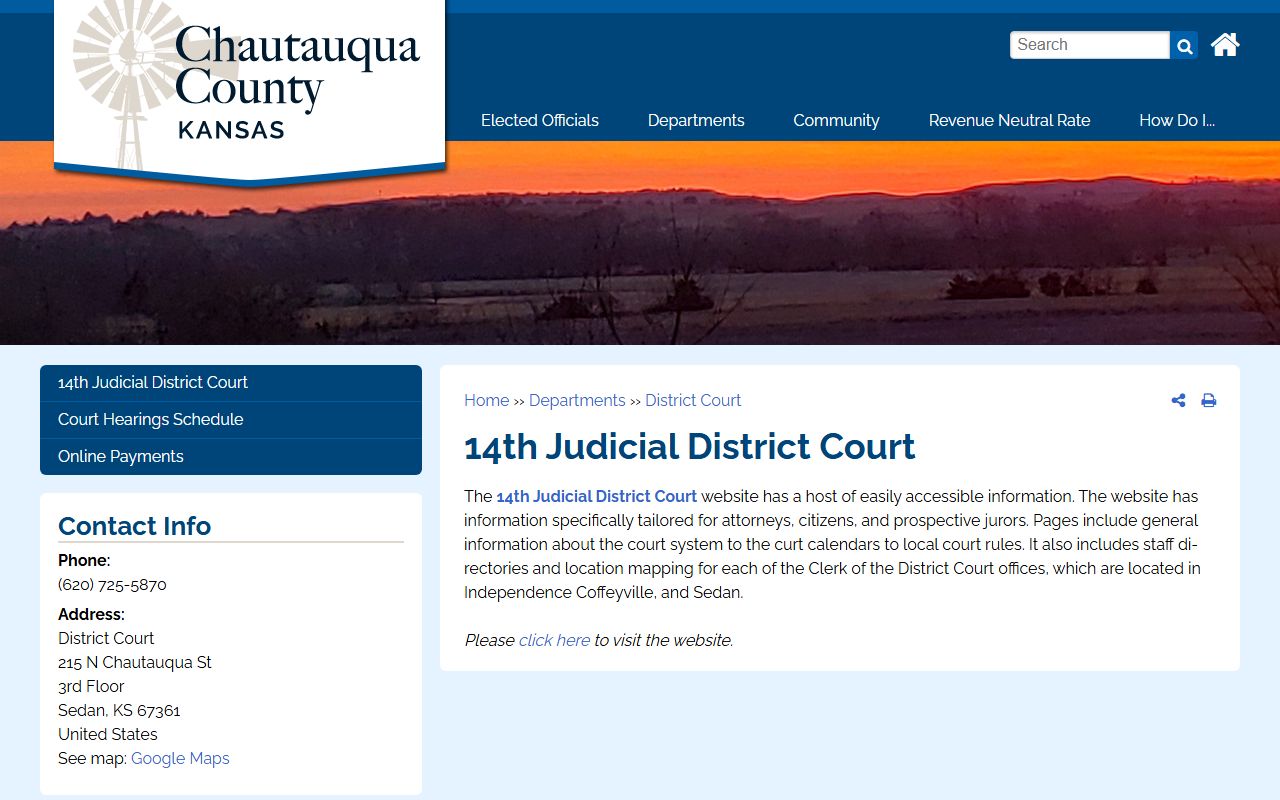
When a case is assigned to the district court, the charge history should be checked there because later filings can change the first charge list.
Chautauqua Arrest Charge Status
Charge status is the current legal state of a count in the court record. It is not the same thing as custody status. A person can be out of jail while a charge is pending, or held in jail while one count is dismissed because another warrant, hold, or case remains active. The court docket and jail record need to be read together.
| Status | Plain Meaning | What to Check |
|---|---|---|
| Pending | The charge is open and has not reached final disposition. | Next hearing, bond terms, attorney entry, and any amended filings. |
| Amended | The filed count changed after the first version. | New statute, level, wording, and whether the older count was replaced. |
| Reduced | The charge moved to a lesser offense or lower level. | Plea terms, journal entry, and sentencing record. |
| Dismissed | The court record shows the count did not proceed to conviction. | Whether dismissal was with or without prejudice and whether other counts remain. |
| Disposed | The count has a final outcome, such as plea, trial verdict, dismissal, or sentence. | Journal entry, sentence, costs, probation, or post-judgment orders. |
A booking charge should not be called a conviction. A filed charge should not be treated as final until the court record shows a disposition. If a case is sealed, expunged, juvenile, or otherwise restricted, public access may be limited under Kansas law.
Court Charges Versus Convictions
Chautauqua County court records after arrest often include allegations before they include final outcomes. The State may file a count and later amend it, dismiss it, or resolve it through a plea. A conviction requires a guilty plea, no-contest plea with finding, or verdict. The difference matters for employment forms, housing forms, professional licensing, and personal record review.
| Point | Charge | Conviction |
|---|---|---|
| Meaning | An accusation filed in court after arrest or warrant action. | A final finding or plea that the person is legally guilty. |
| Timing | Early or mid-case. | After plea, trial, or other final disposition. |
| Record Source | Complaint, information, docket, or amended filing. | Judgment, journal entry, sentence, or disposition line. |
| Risk of Misread | May be mistaken for proven conduct. | May be incomplete without sentence, probation, or appeal details. |
Chautauqua Arrest Bond Records
No Chautauqua County bond schedule or local jail bond-payment page was located in official sources. Bond must be confirmed with the sheriff and the court record. Kansas cases may involve cash bond, surety bond through a licensed agent, appearance bond, release on own recognizance, or a no-bond hold. The County Attorney prosecutes the case, but bond is a court function.
Paying one bond does not always mean release. A person may also have a warrant from another county, a probation or parole hold, a KDOC hold, a federal hold, or an immigration detainer. Those holds can keep the person in custody even when the Chautauqua County bond is paid. Ask the sheriff whether any other agency hold exists before paying money.
| Bond or Hold | How It Affects Release |
|---|---|
| Cash bond | Money is posted as allowed by the court or jail instructions. |
| Surety bond | A bail agent posts bond under the court's terms. |
| Appearance or OR release | The person promises to appear and may not need to post cash. |
| No-bond hold | Release is not available through ordinary bond unless the court changes the order. |
| Outside hold | Another agency or case may prevent release after local bond is handled. |
Chautauqua Arrest Warrants
No official Chautauqua County active-warrant web search or most-wanted page was located. Warrant checks should start with the Chautauqua County Sheriff's Office, the District Court Clerk, and public CaseSearch records when a case is visible. Unofficial warrant sites can be stale, incomplete, or based on copied data with no current hold status.
A warrant can be an arrest warrant for a new allegation, a bench warrant for failure to appear or failure to comply, a probation or parole warrant, or a fugitive warrant from another jurisdiction. A search warrant is different because it authorizes a search, not arrest by itself. If a warrant is confirmed, ask where surrender occurs, whether bond is set, and whether another jurisdiction has a detainer.
Note: A public court case may show a warrant event, but the sheriff is the source for current custody and service status.
KBI Records After Arrest
The KBI criminal-history search is separate from Chautauqua County court records after arrest. Kansas criminal-history records come from the Central Repository and may include information supplied by law enforcement, prosecutors, and courts. That makes the KBI search broader than one district court case, but it is not a jail roster and it is not the same as a certified court file.
The image below comes from the official Kansas criminal-history portal. It is relevant when a person needs a statewide record check instead of a single Chautauqua County court case.
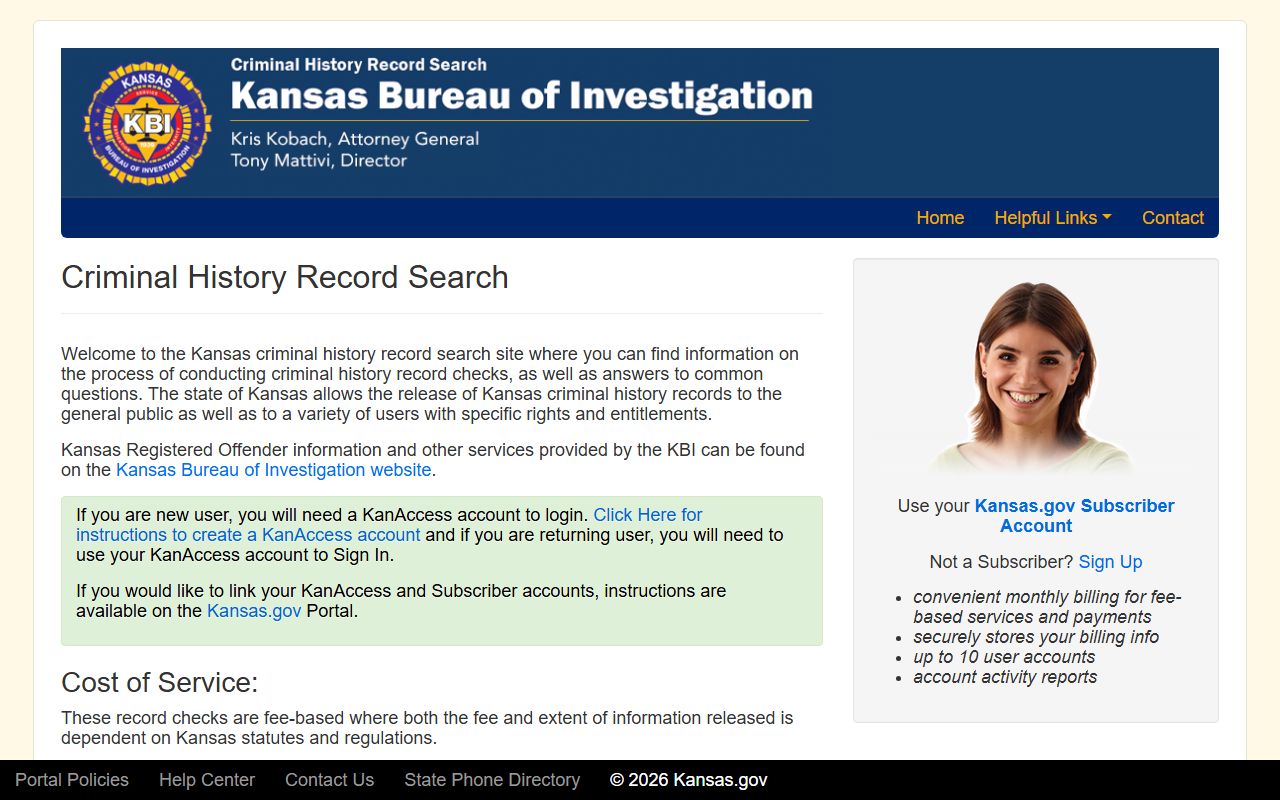
Use KBI for statewide criminal-history checks, CaseSearch for public district court cases, and the District Court Clerk for certified Chautauqua County court records.
Important: This private site is not a consumer reporting agency, and record information cannot be used for FCRA-covered screening.
Sealed and Expunged Records
Kansas public access is governed in part by KORA. K.S.A. 45-215 states the open-records policy, K.S.A. 45-218 addresses access procedures, and K.S.A. 45-221 lists exemptions that can limit release. For eligible criminal matters, K.S.A. 21-6614 is the Kansas expungement statute.
| Term | Public Access Effect | Practical Step |
|---|---|---|
| Sealed | Public access is restricted by court rule, order, or law. | Ask the clerk what can be released and whether a court order is needed. |
| Expunged | Eligible records are removed from ordinary public access under the expungement order. | Use the signed order when contacting the court, sheriff, or records repository. |
| Redacted | Some public parts remain while protected details are hidden. | Request the releasable copy and ask what exemption was applied. |
Juvenile matters, sealed cases, ongoing investigations, protected victim details, expunged records, and certain law-enforcement material may not be fully visible online. If a Chautauqua County court record after arrest appears incomplete, the reason may be timing, portal limits, or a legal restriction.
Public Record Search
Sponsored Results